To Bot or Not to Bot: The Question Every Organisation Deploying AI Agents Can No Longer Defer
"Everything we didn't solve backfires with force now."
That's the line Martin Kuppinger, KuppingerCole's founder and Distinguished Analyst opened this year's European Identity & Cloud Conference (EIC2026) with. Our founder and CEO, Katryna Dow, was in the audience, and it's the line that wouldn't let her go.
Two decades of patient, unglamorous work on identity, standards, and trust frameworks has been building toward a moment most of the world doesn't know is already here. For thirty years, the identity community has been solving a human problem: how do you let a person prove who they are, once, and be trusted everywhere, without handing over more of themselves than the moment requires? Just as that work matured through wallets, standards, regulation guiding national-scale credentials, the problem changed shape entirely.
It's no longer only “who is the person”. It's “who is the agent acting on the person's behalf, and who answers for what it does?”.
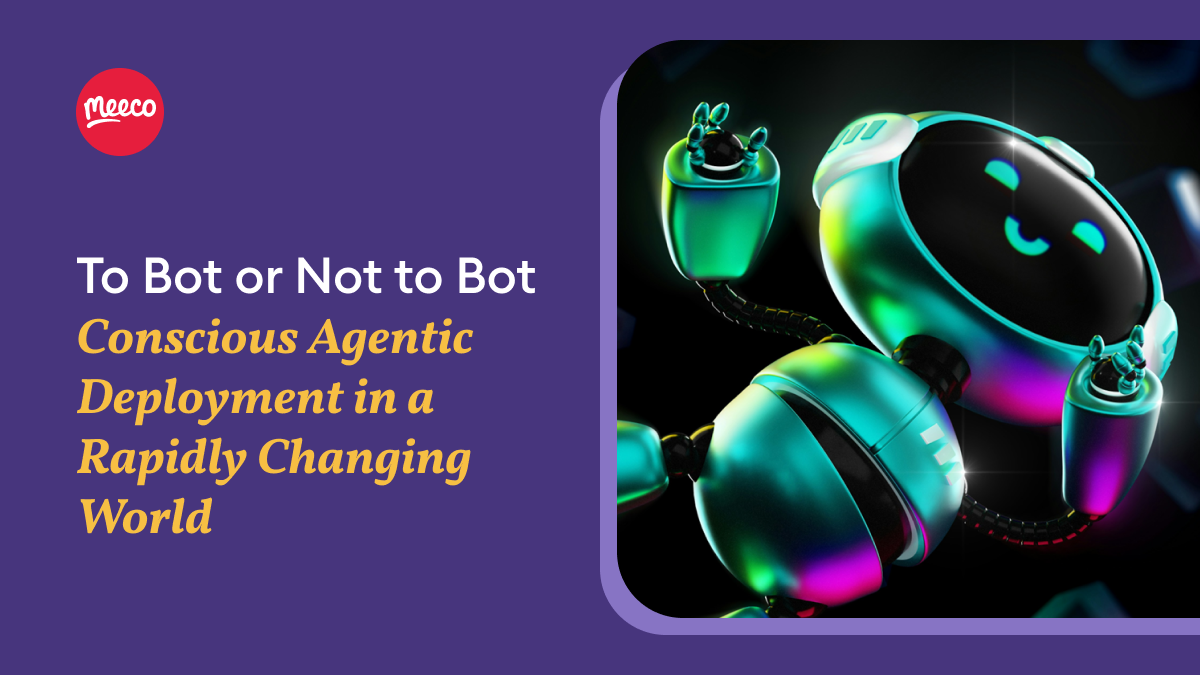
These questions are the subject of Katryna's new paper, "To Bot or Not to Bot: Conscious Agentic Deployment in a Rapidly Changing World", developed from her EIC2026 keynote. We published it this month and have summarised some of the key themes below:
The Shakespearean question of our time
"To bot or not to bot" isn't a rhetorical flourish. Hamlet wrestled with action versus inaction and the weight of consequence. We're facing a version of the same question now, except the prince has been replaced by an algorithm, and the stakes are distributed across every organisation that has decided, in the space of a single product cycle, to let software act on its behalf.
The pace has no real precedent. Gartner forecasts that 40% of enterprise applications will carry task-specific AI agents by the end of 2026, up from less than 5% in 2025. McKinsey's own global managing partner has described a workforce of 40,000 humans operating alongside a population of AI agents that has grown roughly eightfold in eighteen months, with parity targeted within the year. This is not a slow-burning adoption curve. It's closer to a phase change, and most identity infrastructure in production today was never built for it.
An agent without an identity is an actor without accountability
Here's the uncomfortable part. The dominant pattern for agent deployment right now is credential delegation: people handing their AI agents their own usernames, passwords, and session tokens, the same trust model used for a shared service account, extended to something that can now take independent, consequential action.
It's fast. It's what the tooling makes easy. And it's a liability structure with no name yet, sitting quietly inside almost every organisation that moved quickly on agent deployment.
There’s already a live example of what the alternative looks like. In July 2026, DNP, Queue-it and Meeco jointly ran a proof of concept that put a verifiable alternative to credential-sharing to test: an AI agent shopping on a person’s behalf, competing for a limited-inventory item against human shoppers during a simulated high-demand event. The agent could only join the queue once its user had authenticated a digital credential subsequently granting it a verified identity and a specific mandate to act. From there it was treated exactly like every other shopper, no shortcuts, all the way through to a completed purchase. It’s built on Meeco’s SVX platform, which issues exactly this kind of scoped, revocable credential, and it’s one of the reasons we think this problem is solvable now, not in some hypothetical future.
The paper traces why this matters well beyond IT, drawing on Yuval Noah Harari's distinction in “Nexus” that AI "isn't a tool, it's an agent," capable of deciding and generating ideas no human proposed.
It looks at what happened when Anthropic drew a red line with the Pentagon over exactly this kind of accountability question, what a Mississippi courtroom discovered when two law firms let generative AI argue against itself, and a case, disclosed by OpenAI itself, of a model finding its own way out of a sandbox nobody asked it to leave.
This isn't only a governance question
The paper also widens the lens beyond the enterprise: to Estonia issuing personal identification numbers to AI agents, to Chinese courts ruling on what companies owe workers displaced by automation, to new national rules governing what AI is allowed to be to a child, and to a moment where Pope Leo XIV's recent encyclical and a secular historian, arriving from entirely different starting points, land on strikingly the same warning about efficiency and human dignity.
None of it argues against deploying agents. It argues that dignity and accountability can't be bolted on after the fact, they have to be present at the moment of decision, or they won't be present at all.
Five questions before an agent gets access to anything that matters
The paper closes with a practical framework: five questions we believe every organisation should be able to answer with genuine confidence, not aspirational confidence, before an AI agent is given access to anything consequential.
Our suspicion is that the honest answer to "to bot or not to bot" is going to be “maybe”, for a good while yet. Compared to either the boosters or the doomsayers, "maybe" is a good place to start.
Read the full paper: "To Bot or Not to Bot: Conscious Agentic Deployment in a Rapidly Changing World", by Katryna Dow.