At this year's KuppingerCole European Identity & Cloud (EIC) Conference, one theme cuts through every conversation Meeco is part of: identity is no longer just about logging in or proving who you are.
It is becoming the trust layer for digital transactions, cross-border interactions, and increasingly, AI-driven decision making. And the gap between where most organisations are today and where they need to be is widening quickly.
Across three sessions at EIC2026, Meeco and our partners will explore what happens when identity moves beyond static credentials and becomes active infrastructure for trusted digital interactions between people, organisations, wallets, services, and autonomous agents. Each session addresses a different frontier. Together, they describe something that looks very much like the future of the internet.
Why Now? The Pressure Building Beneath the Surface
For years, the digital identity industry focused on authentication, onboarding, and credential exchange. The problems were hard, but they were relatively well-defined: prove who you are, get access, move on.
The challenges of the next phase are broader and less forgiving. AI systems are beginning to initiate actions, exchange information, and participate in workflows autonomously, often at machine speed, without a human in the loop. At the same time, organisations are increasingly operating across borders, trust frameworks, and regulatory environments that were never designed to interoperate. Meanwhile, digital wallets are evolving from simple credential stores into active participants in transaction flows, capable of negotiating, presenting, and receiving verified data on behalf of their owners.
The result is a new set of questions that the industry has not yet fully answered. Who is responsible when an AI agent makes a transaction on your behalf? How do you verify a credential issued in Japan when you're a bank in Australia? How do you build governance structures for systems that operate faster than any human review process?
These are not theoretical questions. Gartner predicts that by the end of 2026, "death by AI" legal claims will exceed 2,000, driven by insufficient AI risk guardrails and rising wrongful harm incidents as AI systems are deployed at scale across high-stakes environments. And yet the governance infrastructure to prevent this is conspicuously absent in most organisations. Whilst the tools to establish verifiable agent identity, enforce policy boundaries, and maintain auditability already exist, what is missing is the urgency and internal governance to deploy them. That gap is precisely what these EIC2026 sessions are designed to address.
These challenges sit at the centre of Meeco's participation at EIC2026.
Wednesday, 20 May
Delegating Digital Identity: Enabling Trusted AI Agents in Transaction Flows
The first question any organisation deploying AI agents needs to answer is not "what can this agent do?" It is "how do others know they can trust it?"
On Wednesday, Akihiko Nawashiro from DNP, Jan Vereecken from Meeco and Morten Holm from Queue-it, will explore how digital identity infrastructure can support AI agents operating within real transaction flows. The session moves well beyond proof-of-concept territory. The focus is on the practical mechanics: how do you establish verifiable authority for an agent? How do you enforce the policies that bound what it can do? How do you maintain an auditable record of its actions? And critically, how do you preserve the user's control when actions are delegated to software that acts on their behalf?
According to a recent Governance Institute of Australia article, the challenge is not simply enabling AI participation in digital ecosystems. Traditional identity systems such as OAuth and SAML were designed for static human users, not the dynamic, autonomous workflows of AI agents which often shift between human and non-human identities as they perform tasks, requiring adaptive access controls that maintain security, accountability, and policy enforcement.
What does a well-governed AI agent look like in practice? It has its own verifiable identity, distinct from the human or organisation that deployed it. It operates within defined policy boundaries. Its actions are attributable and auditable. And when something goes wrong, there is a clear chain of accountability back to a human sponsor. Building that infrastructure and doing so in a way that works across different ecosystems and regulatory environments, is the core challenge this session addresses.
Thursday, 21 May
APDI: Asia Pacific Cross-border Identity Verification in Action
If the AI agent session asks how machines can be trusted to act on our behalf, this session asks a different but equally pressing question: how do people prove who they are when they cross a border, either digital or physical?
On Thursday, Katryna Dow will host a panel featuring Rintaro Okamoto from DNP, Jihyun Jang from Lordsystem, Naohiro Fujie from CTC / OpenID Foundation Japan, and Meeco's Jan Vereecken to present a progress update on the Asia Pacific Digital Identity (APDI) Consortium, a real-world initiative that has been quietly building something genuinely significant. This is the third consecutive year that DNP has partnered with Meeco and other contributors to advance the work, and the results are no longer theoretical.
APDI is the Asia-Pacific region's first international organisation dedicated to cross-border digital identity, with founding members from Japan and Taiwan and core members from Singapore, South Korea, and Myanmar. Its ambition is to become a gateway connecting the Asia-Pacific with global digital trust initiatives, building a transnational digital identity economic zone that serves a region of 4.78 billion people across 36 countries.
The session will demonstrate interoperability in practice: digital identity data issued in one country, verified in another, across differing trust frameworks, standards, languages, and regulatory environments.
Real-world use cases are now operational, including a continuous travel journey using a single digital ID from departure to return, covering identity verification, transportation, payment, and tax refund processes, with service models now being expanded globally. Consider what that means concretely: a Korean traveller checking into a hotel in Tokyo, their digital ID verified instantly and securely, without the friction of physical document handling or the risk of unnecessary data exposure. This is not a future state, it is working infrastructure being expanded right now following the presentation at last year's EIC2025.
None of this is possible without standards. The ability to issue a credential in Seoul and have it accepted in Tokyo depends entirely on agreed protocols, shared trust frameworks, and common data models sitting beneath the user experience. Jan Vereecken will address how this technical layer is being built and why getting it right matters enormously, not just for travel use cases, but for every cross-border interaction that follows. He will be joined in that conversation by Naohiro Fujie, Chair of the OpenID Foundation Japan, whose work on open identity standards has been instrumental in creating the common ground that consortia like APDI depend on. The message from both will be the same: interoperability is not an engineering footnote. It is the political and technical agreement that makes trusted cross-border identity possible at all, and the standards bodies such as OpenID Foundation, ISO, W3C, IETF and others, doing this work quietly and persistently are what turn ambitious pilots into durable global infrastructure.
The implications stretch well beyond travel. The same infrastructure that lets a Korean traveller use their digital ID at a Japanese hotel is the infrastructure that underpins secure cross-border employment verification, student exchange, financial services access, and eventually, the kind of trusted data exchange that AI agents will need to operate across jurisdictions. Interoperability, as this session will make plain, can no longer be treated as optional.
Thursday, 21 May (Keynote)
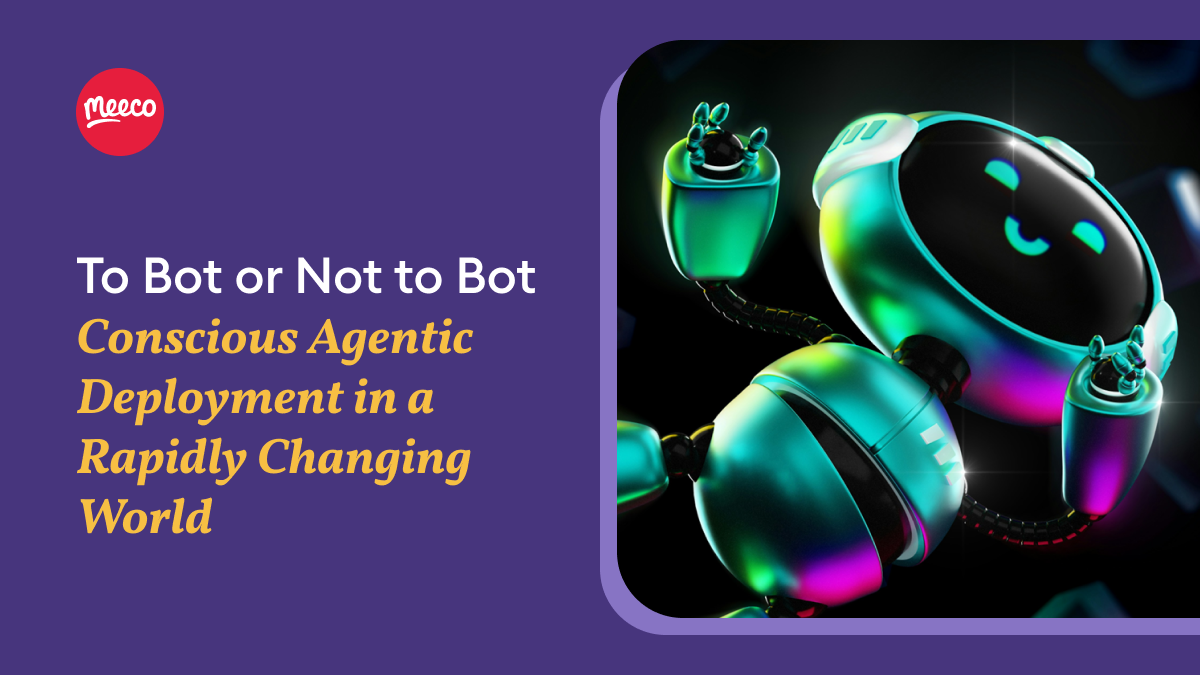
To Bot or Not to Bot: Identity Accountability & Governance in AI Agents
Later that same afternoon, Katryna Dow will take to the main stage for a keynote that addresses what may be one of the most consequential governance questions of this decade: when AI agents act independently initiating workflows, making decisions, participating in transactions, how do we establish accountability?
This is a question that organisations are already wrestling with operationally, not just theoretically. McKinsey's 2026 AI Trust Maturity Survey found that while technical and risk management capabilities are advancing, only around one-third of organisations report meaningful maturity in agentic AI governance, suggesting that organisational alignment and oversight structures are struggling to keep pace with the rapid expansion of AI deployment.
The keynote will explore what identity-based governance looks like in agentic systems: the mechanics of delegated authority, the importance of auditability, the question of data access and policy enforcement, and, perhaps most importantly, the difference between compliance theatre and genuine accountability. As organisations move from pilots to production-scale agentic deployments, these questions move from the IT architecture team to the boardroom. The ability to verify who or what initiated an action, under what authority, and within which policy boundaries is fast becoming a core requirement for operating in regulated markets.
Identity Infrastructure for Digital Trust
Each of these three sessions approaches digital identity from a different angle. The AI agent sessions ask how machines can be trusted to act autonomously. The APDI session asks how identity can travel across borders and ecosystems. But they converge on the same underlying conclusion.
The future of identity is not a standalone wallet or an isolated verification flow. It is interoperable trust infrastructure. Infrastructure that enables trusted transactions, AI-assisted interactions, cross-border verification, delegated authority, privacy-preserving data exchange, and evolving regulatory compliance, all within a single coherent architecture.
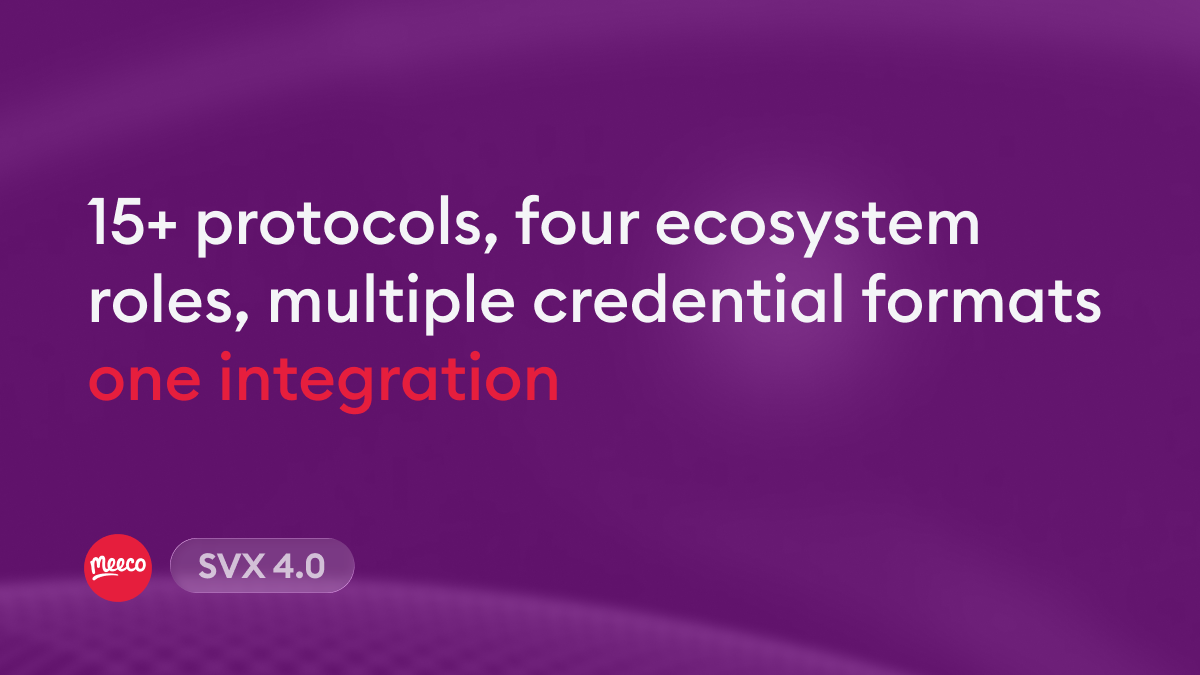
This is the direction driving the upcoming release of Meeco's SVX 4.0 platform. Built for issuers, verifiers, wallet providers, and scheme operators participating in regulated environments, SVX addresses the complexity of modern digital identity ecosystems head-on: 15+ protocols, four ecosystem roles, multiple credential formats - one integration.
As standards evolve, regulations expand, and new transaction models emerge, organisations need infrastructure built to adapt alongside them, not platforms that will need to be replaced every time the landscape shifts.
See You at EIC2026
If you are attending the European Identity & Cloud Conference 2026, we would very much like to meet you. Come and join us across these sessions to explore how digital identity is evolving from authentication infrastructure into the trust layer for AI, wallets, and cross-border digital interactions.
And watch this space in June for the release of SVX 4.0.