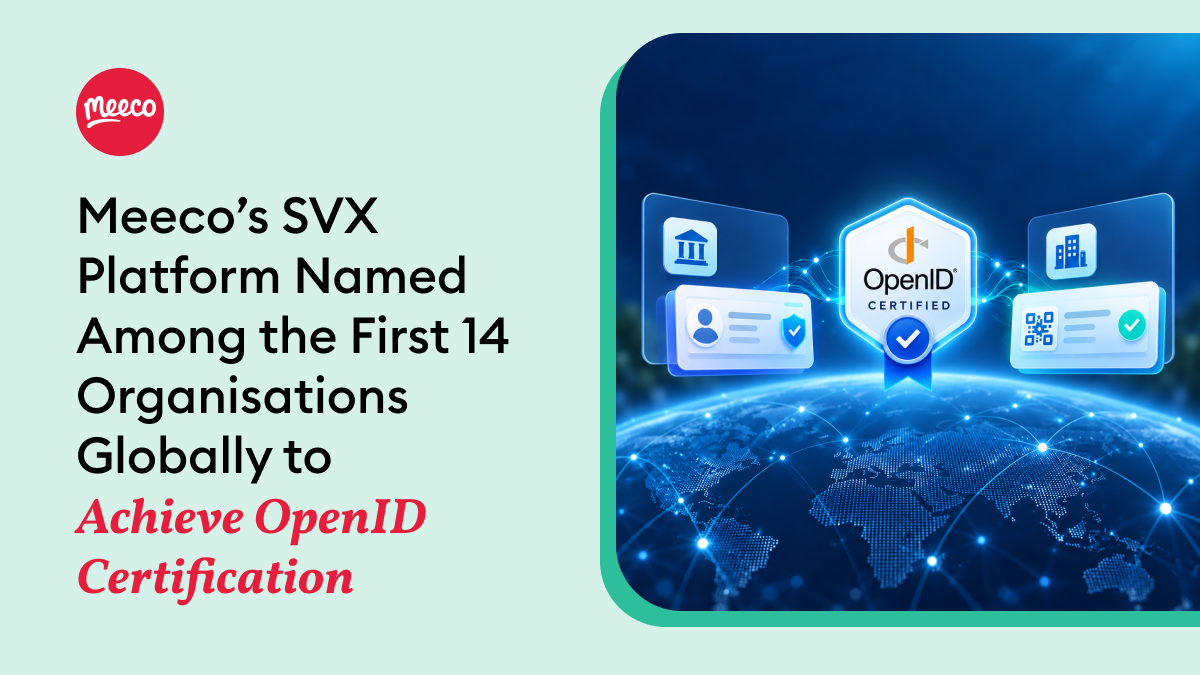
Meeco’s SVX Platform has been named as one of the first 14 organisations globally, to achieve OpenID Certification for OpenID for Verifiable Presentations (OpenID4VP) and OpenID for Verifiable Credential Issuance (OpenID4VCI) with the High Assurance Interoperability Profile (HAIP).
The OpenID Foundation announced the first cohort on 24 September 2026, confirming that their implementations had passed its conformance tests and that the results were available on public record for partners, customers and regulators to review.
Of the first cohort, Meeco is also one of just six organisations certified across both the Issuer and Verifier roles, demonstrating SVX’s conformance across two fundamental parts of the digital credential lifecycle: issuing trusted credentials and enabling those credentials to be securely presented and verified.
Meeco’s SVX 4.2.0 is officially listed by the OpenID Foundation in both the OpenID4VCI Issuer certification register and the OpenID4VP Verifier certification register.
This is an important milestone and provides publicly verifiable evidence that SVX implements key open standards for digital credentials in accordance with the specifications and conformance requirements established by the OpenID Foundation.
What has SVX been certified for?
SVX has achieved OpenID Certification across two core roles within a verifiable credential ecosystem.
OpenID4VCI 1.0 + HAIP 1.0: Issuer
OpenID4VCI defines how digital credentials are securely issued to wallets. SVX can provide the infrastructure behind an organisation issuing credentials, enabling standards-based credential issuance rather than relying on proprietary wallet integrations.
The OpenID Foundation’s OpenID4VCI certification register confirms that SVX 4.2.0 has achieved Issuer certification across both SD-JWT VC and mdoc credential formats, including issuer-initiated and wallet-initiated profiles.
OpenID4VP 1.0 + HAIP 1.0: Verifier
OpenID4VP defines how digital credentials held in a wallet are requested, presented and verified. SVX enables organisations to request and verify credentials from compatible wallets using the same standardised protocol.
SVX 4.2.0 is listed in the OpenID Foundation’s OpenID4VP certification register as a certified Verifier for both SD-JWT VC and ISO mDL profiles.
Both certifications incorporate the High Assurance Interoperability Profile (HAIP). The profile establishes common requirements for using OpenID4VCI and OpenID4VP in higher-assurance digital identity environments, helping independently developed implementations operate consistently and securely.
Why OpenID Certification matters
Open standards provide the foundation for interoperable digital identity ecosystems, but supporting a standard and demonstrating conformance to it are not the same thing.
Before these conformance tests were available, implementers primarily tested directly against other implementations. When two systems failed to interoperate, determining which implementation had diverged from the specification could be difficult.
The OpenID Foundation’s conformance programme addresses this by testing implementations against the specifications themselves. Importantly, the testing considers not only what an implementation should successfully process, but also what it should reject, as incorrect handling of these interactions can create security and interoperability issues.
Certification therefore provides a publicly verifiable baseline. Governments, regulators, relying parties, partners and customers can check whether an implementation has successfully completed the applicable conformance tests rather than relying solely on a vendor’s claim that a product supports a particular standard.
As the OpenID Foundation explains, certified implementations help ecosystems realise the security, privacy and interoperability benefits intended by the protocols while reducing the effort required to establish whether counterparties have implemented the standards correctly.
From standards support to proven conformance
Open standards have long been central to SVX’s architecture.
Achieving certification for OpenID4VCI and OpenID4VP takes this commitment a step further. Rather than simply stating that SVX supports these protocols, Meeco can now point to conformance testing and certification results published by the OpenID Foundation.
This distinction is becoming increasingly important as OpenID4VP and OpenID4VCI are adopted by digital identity and wallet programmes internationally. According to the OpenID Foundation, the specifications have been selected by more than 30 jurisdictions, including the United Kingdom, Switzerland, India and EU Member States through the EU Digital Identity Wallet programme.
The Foundation completed the conformance test suites for OpenID4VP and OpenID4VCI with HAIP in August 2026, enabling wallet providers, issuers, verifiers, government agencies and technology vendors to formally demonstrate conformance.
For the product team at Meeco, OpenID’s conformance test suite was and still is an invaluable tool during the development of our SVX Platform. It ensures consistent interpretation and implementation of the relevant specifications for developers in our organisation, but also with those of different vendors. With it, real-world interoperability becomes that much easier.
The certification programme serves as a useful signal to customers and external stakeholders that Meeco is able to help them on their digital credentials journey.
– Jan Vereecken, CPO
What this means for current and future SVX customers
For existing SVX customers, certification provides additional assurance that the platform’s issuance and verification capabilities have been tested against recognised industry specifications.
For organisations currently evaluating digital credential infrastructure, it provides a clearer basis for technical due diligence. Instead of relying solely on a vendor stating that its platform supports OpenID4VC, organisations can verify whether the implementation has successfully completed the relevant OpenID Foundation certification programme and for which roles.
In practical terms, certification can help organisations:
- Reduce interoperability risk when integrating with standards-conformant wallets and digital credential ecosystems.
- Reduce implementation uncertainty by demonstrating that core protocol behaviour has been tested against the relevant specifications.
- Support procurement and assurance activities with certification results published by an independent standards body.
- Prepare for emerging digital identity ecosystems adopting OpenID4VC protocols and HAIP.
- Establish a stronger foundation for cross-border use cases, where independently developed issuers, wallets and verifiers need to exchange credentials reliably.
The OpenID Foundation specifically identifies certification as a means for governments, regulators, relying parties and customers to determine which implementations have demonstrated conformance without having to perform the same assessment themselves.
Certification does not replace ecosystem-specific integration and interoperability testing. What it provides is a trusted baseline that demonstrates the underlying implementation has been tested against the specifications being adopted by other ecosystem participants.
Building interoperable digital trust infrastructure
SVX is designed to enable organisations to participate in digital credential ecosystems across a range of roles, including issuer, verifier, wallet provider and ecosystem operator.
Achieving OpenID Certification across both issuance and verification is therefore particularly significant for SVX. It demonstrates conformance for two of the core functions required to exchange trusted digital credentials across organisational and technological boundaries.
Being part of the OpenID Foundation’s first cohort of 14 organisations, globally, to achieve OpenID Certification, and one of just six organisations certified across both the Issuer and Verifier roles, represents an important milestone for SVX and reinforces Meeco’s commitment to building interoperable digital trust infrastructure based on open standards.
As governments, businesses and digital ecosystems increasingly move from experimentation to production deployment, independently demonstrated standards conformance provides customers and partners with greater confidence that the infrastructure they adopt is designed to participate in an open, interoperable digital identity ecosystem.